4×4 Garden Bed Layout: 10 Plans That Maximize Every Sq Ft
A 4×4 raised bed gives you 16 square feet to grow real food — compact enough to manage in an afternoon. Here are 10 complete layouts you can copy directly into your garden today.
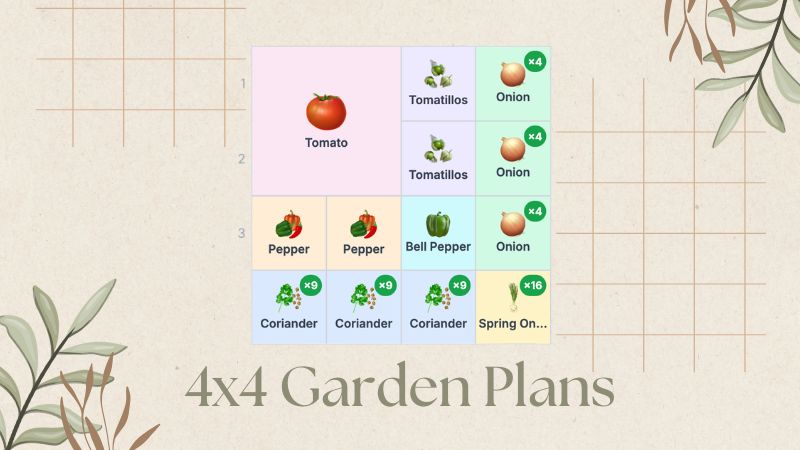
A 4×4 raised bed is the garden most people actually have room for. Sixteen square feet fits on a balcony, in a side passage, against a fence, or on any flat patch of ground. It can be built from lumber in an afternoon, filled with quality growing mix, and planted the same weekend.
And when it is laid out properly — not just filled with whatever was at the garden centre — it produces an amount of fresh food that consistently surprises first-time growers.
The difficulty is that 16 square feet rewards careful planning more than any other bed size. There is no room to waste a square foot on overcrowded seedlings or a squash that claims the entire north end. Every placement decision matters.
This guide covers how square foot gardening works in a 4×4 context and gives you ten complete layouts — covering herbs, salad greens, summer kitchens, Asian cooking, tropical crops, and low-maintenance root beds — each ready to copy directly into your own garden.
Why a 4×4 Bed Rewards Proper Planning
In a larger garden, spacing mistakes get absorbed. A plant that spreads further than expected just nudges its neighbours. A crop that underperforms leaves a gap that another fills.
In a 4×4 bed, there is no slack. Sixteen square feet divided into one-foot squares gives you exactly sixteen planting zones. Put a zucchini in the wrong spot and it can shade four adjacent squares. Overplant a corner with seedlings and the entire section fails to mature properly.
The same constraint that makes a 4×4 unforgiving is also what makes it rewarding.
A well-planned 4×4 bed — with the right crops in the right squares, companions grouped together, and tall plants on the north side — produces more food per square foot than a larger bed managed casually.
Intensive growing in a confined space forces you to think about every decision, and when those decisions are good, the result is a bed that produces almost continuously from spring through autumn.
What Fits in 16 Square Feet
Square foot gardening assigns each crop a planting density — how many plants fit in a single one-foot square — based on the plant's mature spread.
In a 4×4 bed, you have 16 of those squares to allocate. The critical skill is understanding which crops need space and which can be packed densely.
| Crop | Plants per sq ft | Space needed in a 4×4 | Notes |
|---|---|---|---|
| Tomato (indeterminate) | 1 per 4 sq ft | 1 plant uses 4 sq ft | Limit to 1 plant per 4×4; stake vertically |
| Pepper / Bell Pepper | 1 per sq ft | 2–4 plants uses 2–4 sq ft | Compact; works well as a mid-height filler |
| Zucchini / Courgette | 1 per 4 sq ft | 1 plant maximum in a 4×4 | Sprawling; keep to one plant or it dominates |
| Lettuce (loose-leaf) | 4 per sq ft | 16 plants uses 4 sq ft | Tolerates partial shade; great under climbing crops |
| Spinach | 9 per sq ft | 18 plants uses 2 sq ft | Quick-maturing; ideal for succession sowing |
| Carrot | 16 per sq ft | 32 carrots uses 2 sq ft | Needs loose, deep, stone-free growing mix |
| Basil | 4 per sq ft | 4–8 plants uses 1–2 sq ft | Plant near tomatoes and peppers; repels aphids |
| Garlic | 4 per sq ft | 8–16 cloves uses 2–4 sq ft | Deters most pests; good neighbour throughout the bed |
| Beans (bush) | 4 per sq ft | 8–16 plants uses 2–4 sq ft | Fixes nitrogen; good before or alongside heavy feeders |
| Cucumber | 2 per sq ft | 2–4 plants uses 1–2 sq ft | Train vertically on a trellis to save ground space |
The practical rule for a 4×4: one or two large crops (tomato, zucchini, eggplant) supported by compact fillers (peppers, herbs, onions) and dense edge plantings (spinach, lettuce, carrot). That combination uses every square foot without overcrowding.
10 Complete 4×4 Garden Bed Layouts
Each plan below was built in EdenVatika's bed designer. You can view the full grid layout and copy any of them directly into a free account — spacing is calculated, companion pairings are built in, and you can adjust the layout for your season, region, or crop preferences.
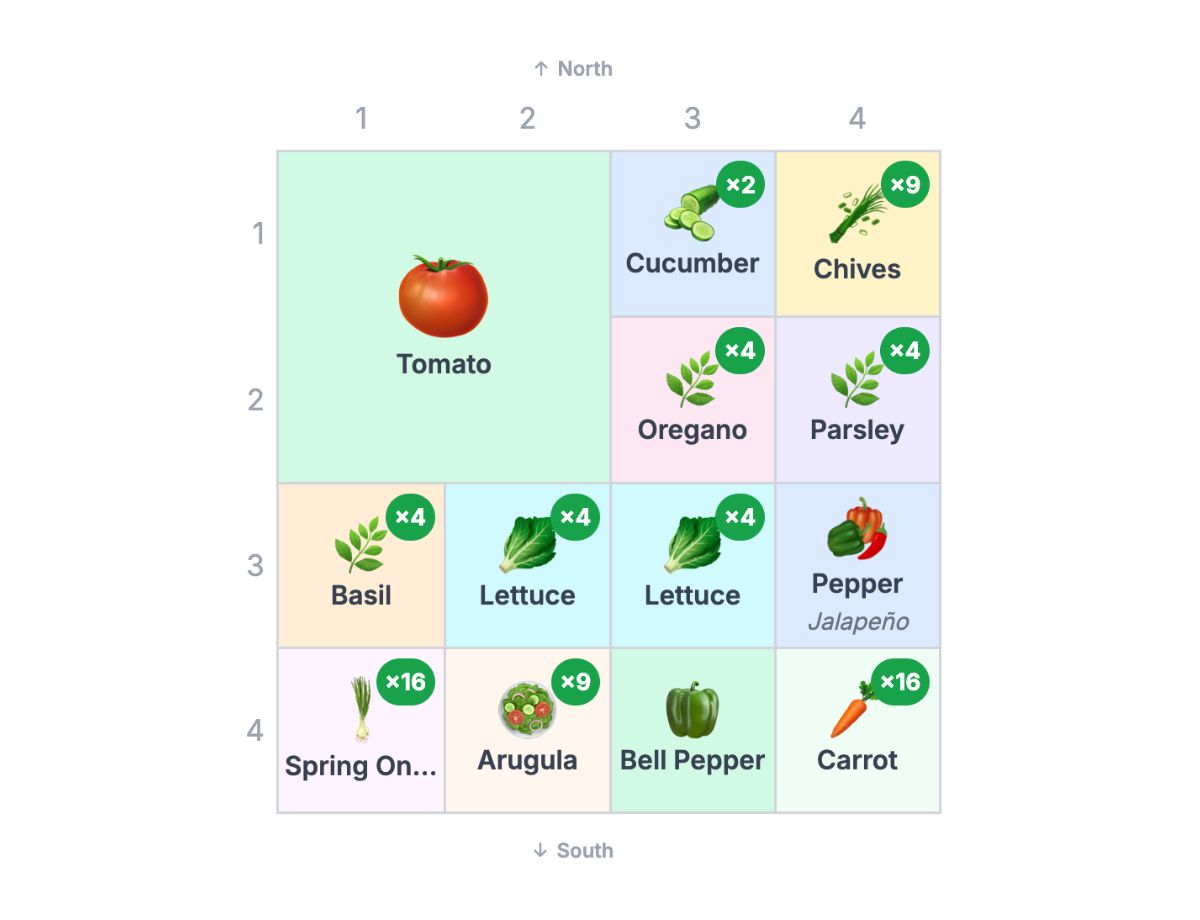
Plan 1 — Fresh Herb & Salad Bed
This is the 4×4 layout for anyone who cooks with fresh herbs daily and wants a constant supply of salad greens alongside.
Tomato and cucumber anchor the bed as the main producers, with basil, oregano, parsley, and chives filling the remaining squares — all within arm's reach of a kitchen door.
The lettuce and arugula occupy the shadier corners, making use of the microclimate created by the taller crops. Spring onion and carrot fill the gaps.
The bed produces continuously through summer: harvest herbs regularly to keep them producing, and the salad greens will regenerate from the base.
What's in it: Tomato, Cucumber, Lettuce, Carrot, Bell Pepper, Jalapeño, Basil, Oregano, Parsley, Chives, Arugula, Spring Onion
Best for: Cooks who want fresh herbs and daily salad greens | Season: Late spring through summer
View the full grid layout, see companion pairings, and copy this plan to your account.
View & Copy This Plan → Free account required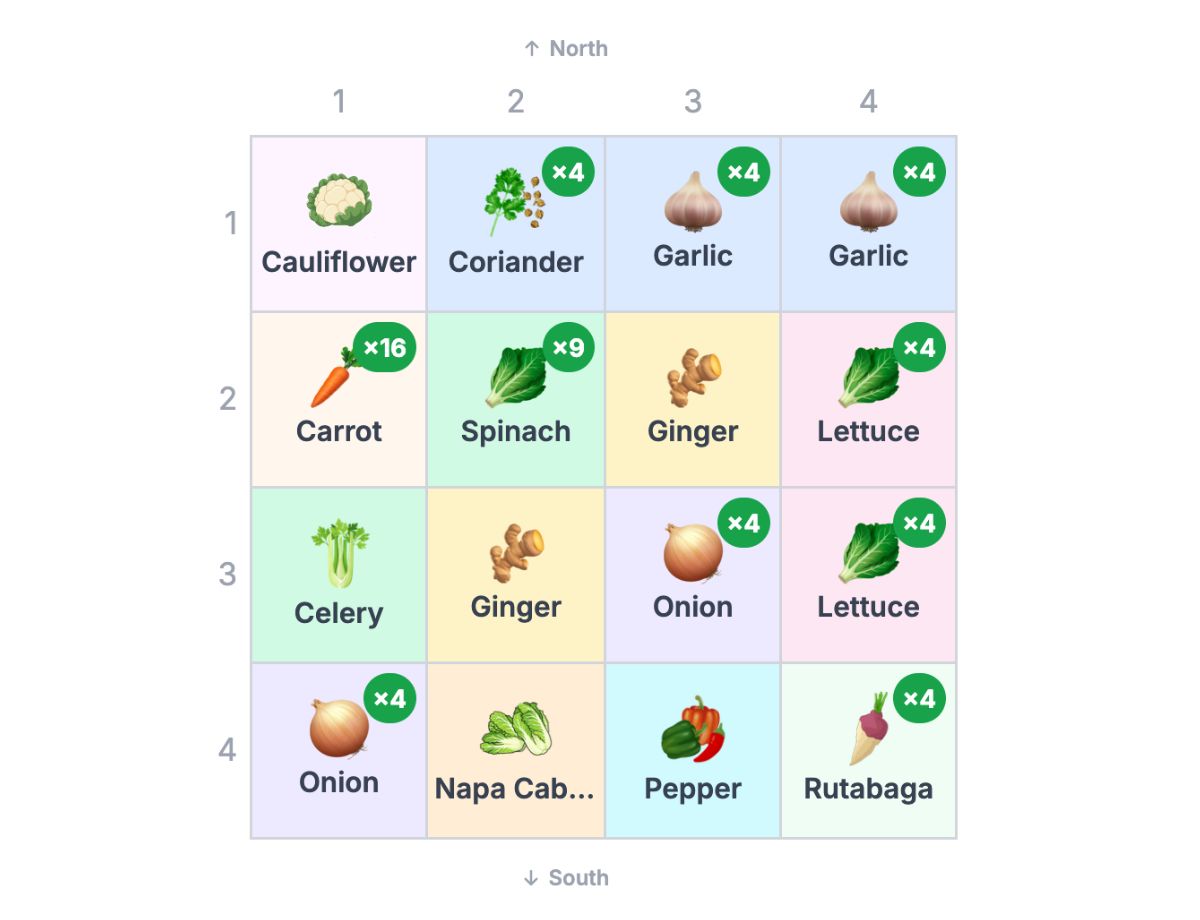
Plan 2 — Cool Season Harvest Bed
This layout is built around crops that thrive when temperatures drop — the opposite of the summer kitchen plans. Cauliflower, napa cabbage, and rutabaga take the dominant positions. Carrot, spinach, lettuce, and onion fill the smaller squares.
Coriander and garlic act as companion anchors, deterring pests and improving the flavour of the root crops growing nearby.
The bed performs best planted in late summer for an autumn harvest, or in early spring while nights are still cool. When the temperature climbs past 25°C, the brassicas and greens will bolt — that is the signal to clear the bed and replant for summer.
What's in it: Cauliflower, Coriander, Garlic, Carrot, Spinach, Ginger, Lettuce, Celery, Onion, Napa Cabbage, Pepper, Rutabaga
Best for: Spring and autumn growing, cool-climate growers | Season: Early spring or late summer into autumn
View the full grid layout, see companion pairings, and copy this plan to your account.
View & Copy This Plan → Free account required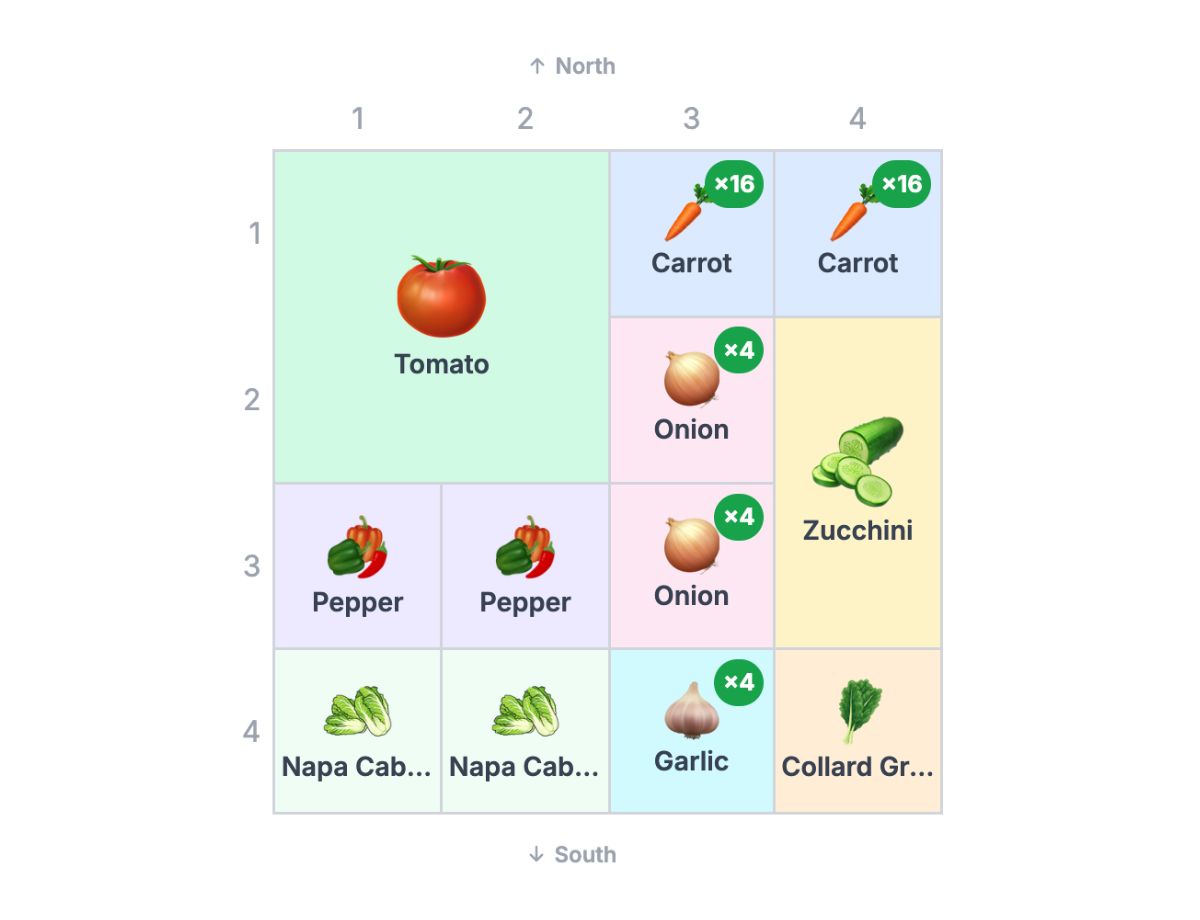
Plan 3 — Summer Kitchen Bed
Everything in this plan goes from garden to kitchen. Tomato, zucchini, and pepper are the workhorses — the crops you harvest from every few days through summer.
Napa cabbage and collard greens add leafy bulk for salads and stir-fries. Onion and garlic sit in the corners and double as pest deterrents throughout the season.
This is a well-rounded 4×4 for households that cook regularly and want to reduce their weekly shop. Carrot rounds out the root section.
The layout handles both short and long harvest windows well — zucchini and tomatoes produce heavily in the middle of summer, while the greens and root crops extend into cooler weather.
What's in it: Tomato, Carrot, Zucchini, Onion, Pepper, Collard Greens, Garlic, Napa Cabbage
Best for: Household kitchen gardens, reducing the weekly grocery shop | Season: Summer
View the full grid layout, see companion pairings, and copy this plan to your account.
View & Copy This Plan → Free account required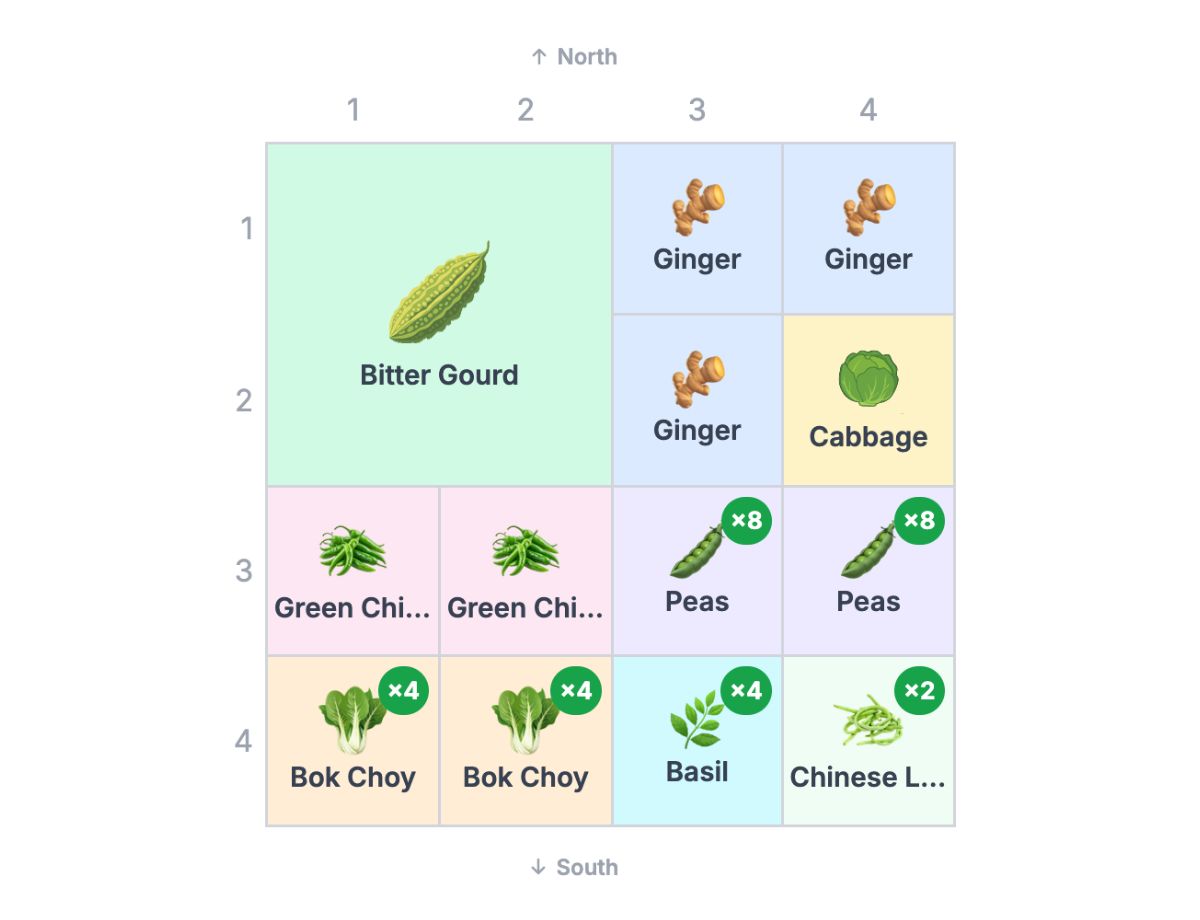
Plan 4 — Compact Stir-Fry Bed
This layout is built around the crops that go into a wok. Bitter gourd climbs vertically, keeping its footprint small while producing throughout the hot months.
Bok choy, Chinese long beans, and cabbage fill the mid-section. Green chillies and ginger sit in the outer squares, ready to harvest in small amounts as needed.
Peas add nitrogen to the soil while producing their own harvest. Basil in one corner attracts pollinators and keeps aphid pressure down.
The plan works exceptionally well in compact urban spaces and produces a harvest that translates directly into weeknight dinners.
What's in it: Bitter Gourd, Ginger, Cabbage, Green Chillies, Peas, Bok Choy, Basil, Chinese Long Beans
Best for: Asian cooking enthusiasts, compact urban gardens | Season: Warm season
View the full grid layout, see companion pairings, and copy this plan to your account.
View & Copy This Plan → Free account required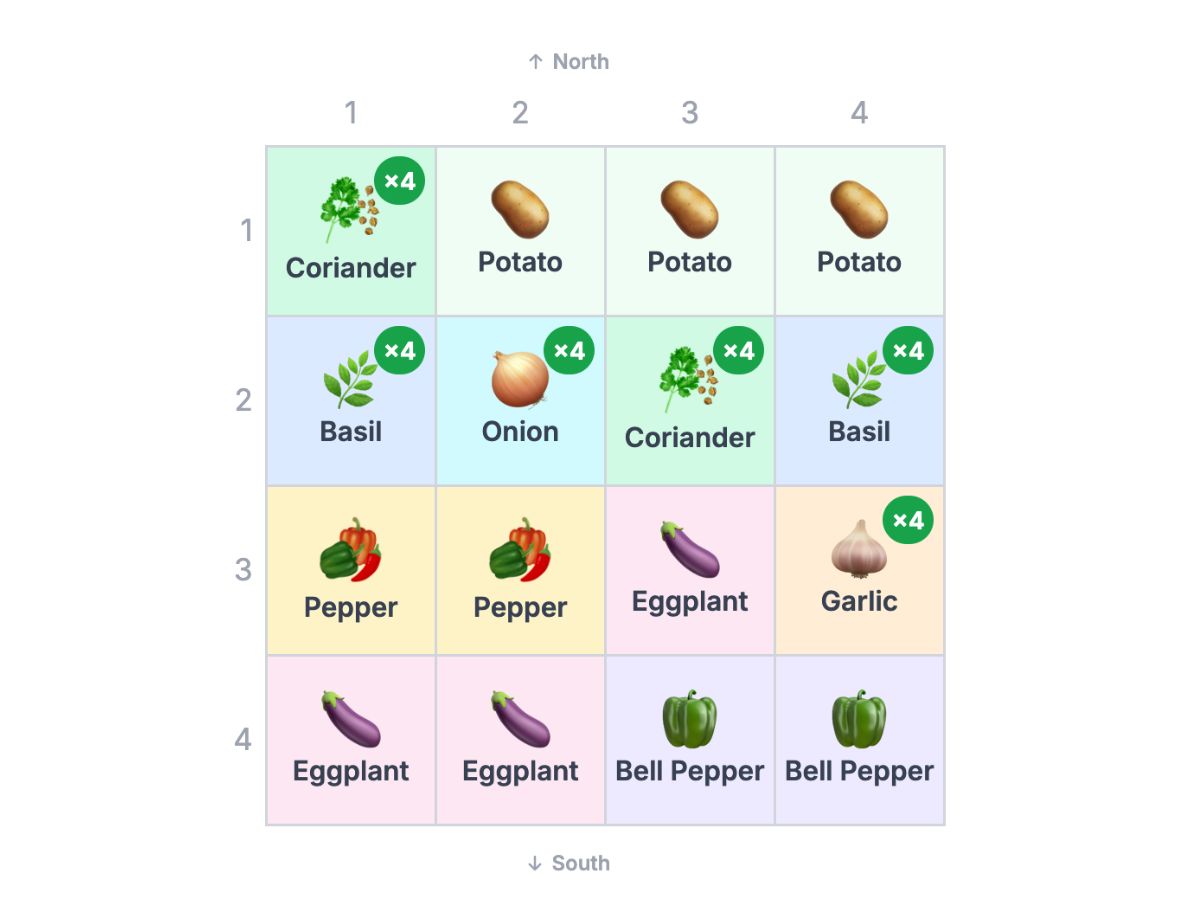
Plan 5 — Everyday Cook's Bed
This is the 4×4 you plant when you want to stop buying the same five things from the supermarket every week.
Eggplant, pepper, bell pepper, onion, and garlic form the backbone — crops used in almost every cuisine and expensive to buy in quality at retail. Potato fills the remaining squares, producing a meaningful harvest from a surprisingly small footprint.
Coriander and basil sit in the outer squares as both culinary herbs and companion plants.
The basil-pepper pairing reduces aphid pressure; the onion-pepper combination deters generalist pests. This bed is deliberately focused on high-use, high-cost grocery staples.
What's in it: Coriander, Basil, Pepper, Eggplant, Bell Pepper, Garlic, Onion, Potato
Best for: Cost-conscious gardeners, everyday home cooks | Season: Summer
View the full grid layout, see companion pairings, and copy this plan to your account.
View & Copy This Plan → Free account required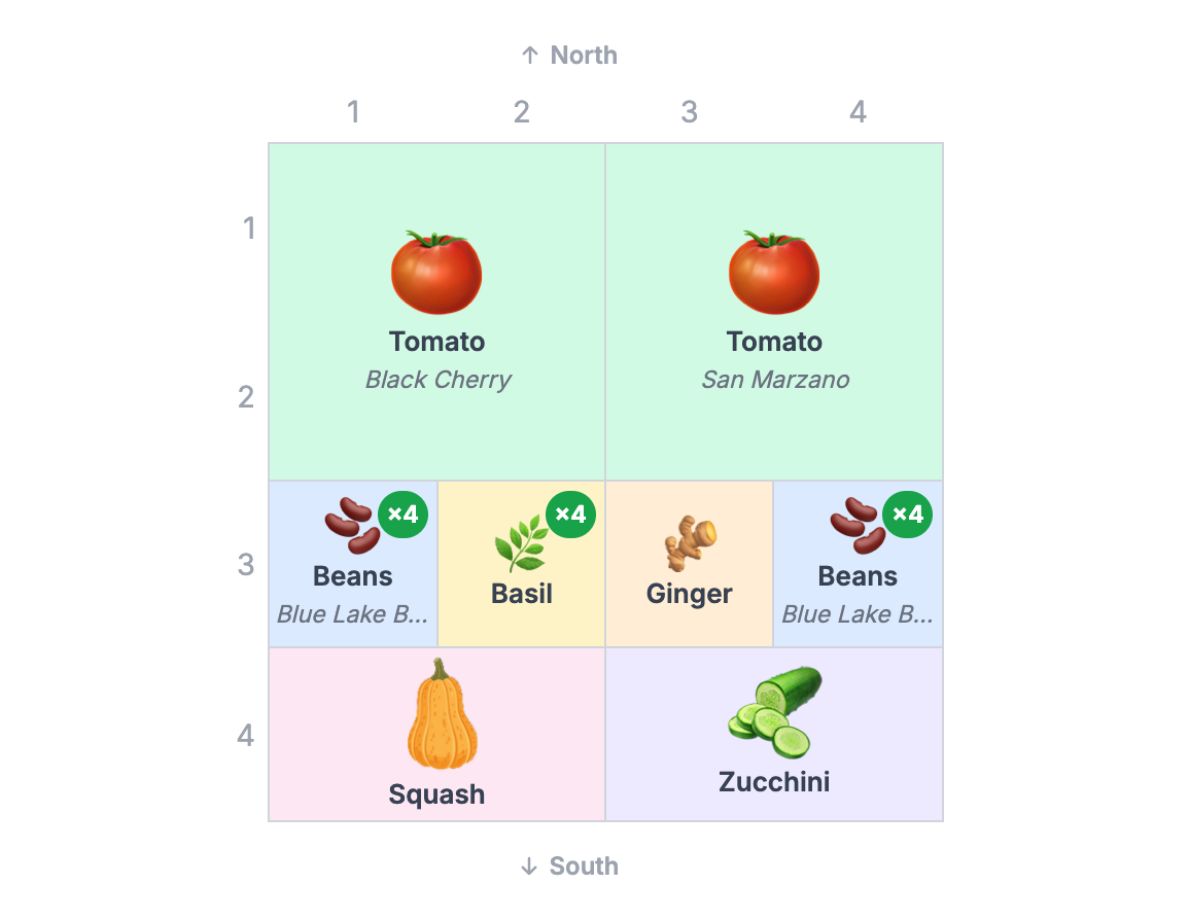
Plan 6 — Heirloom Tomato & Companions Bed
This layout is built around two specific tomato varieties — Black Cherry and San Marzano — chosen for flavour rather than supermarket availability. Black Cherry is prolific and sweet.
San Marzano is the classic plum tomato for sauces. Blue Lake Bush beans grow alongside, fixing nitrogen that the heavy-feeding tomatoes use during fruiting.
Basil sits directly adjacent to both tomato plants — the pairing improves tomato flavour and reduces pest pressure simultaneously.
Zucchini fills one square and ginger provides a low-growing corner crop with both culinary and companion value. This is a small bed that punches above its size in flavour and variety.
What's in it: Tomato (Black Cherry), Tomato (San Marzano), Beans (Blue Lake Bush), Basil, Zucchini, Ginger
Best for: Tomato enthusiasts, home sauce makers | Season: Summer
View the full grid layout, see companion pairings, and copy this plan to your account.
View & Copy This Plan → Free account required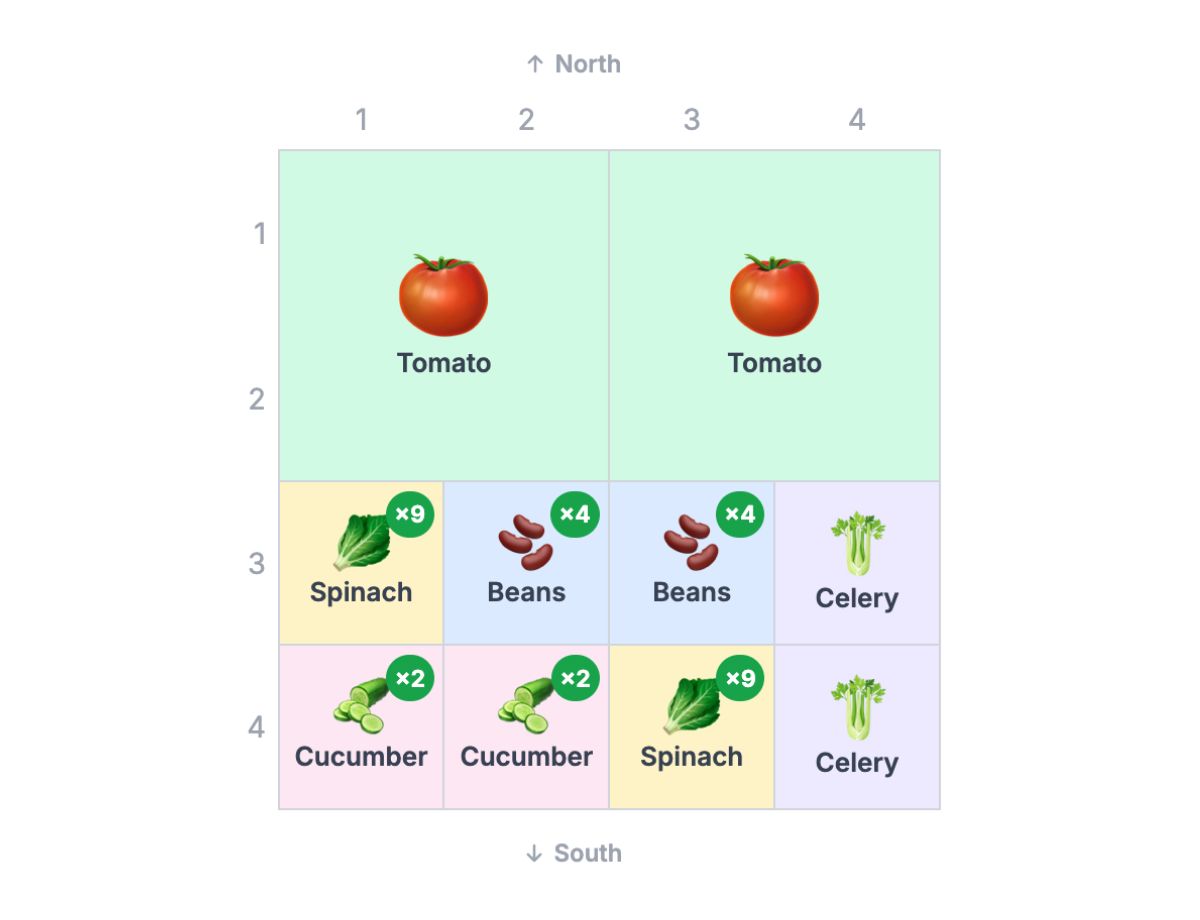
Plan 7 — Companion Planting Starter Bed
This plan is designed for growers who want to learn how companion planting actually works in practice, in a bed small enough to observe closely.
Every plant combination in the layout is a proven pairing: beans and celery are mutually beneficial, cucumber and beans share a nitrogen relationship, and spinach and celery grow alongside each other without competition.
With only five plant varieties, the bed is simple enough for a complete beginner while demonstrating genuine companion dynamics.
The beans fix nitrogen that benefits both spinach and cucumber. Celery repels pests that would otherwise target the tomato.
If you have never tried companion planting before, this is the right bed to start with.
What's in it: Tomato, Beans, Spinach, Cucumber, Celery
Best for: Beginners learning companion planting, low-variety intensive growing | Season: Summer
View the full grid layout, see companion pairings, and copy this plan to your account.
View & Copy This Plan → Free account requiredWant to build your own 4×4 layout from scratch?
EdenVatika's bed designer lets you set a 4×4 grid, drag plants into place, and see spacing, companion suggestions, and incompatibility warnings in real time — free for up to two beds.
Start Planning Free →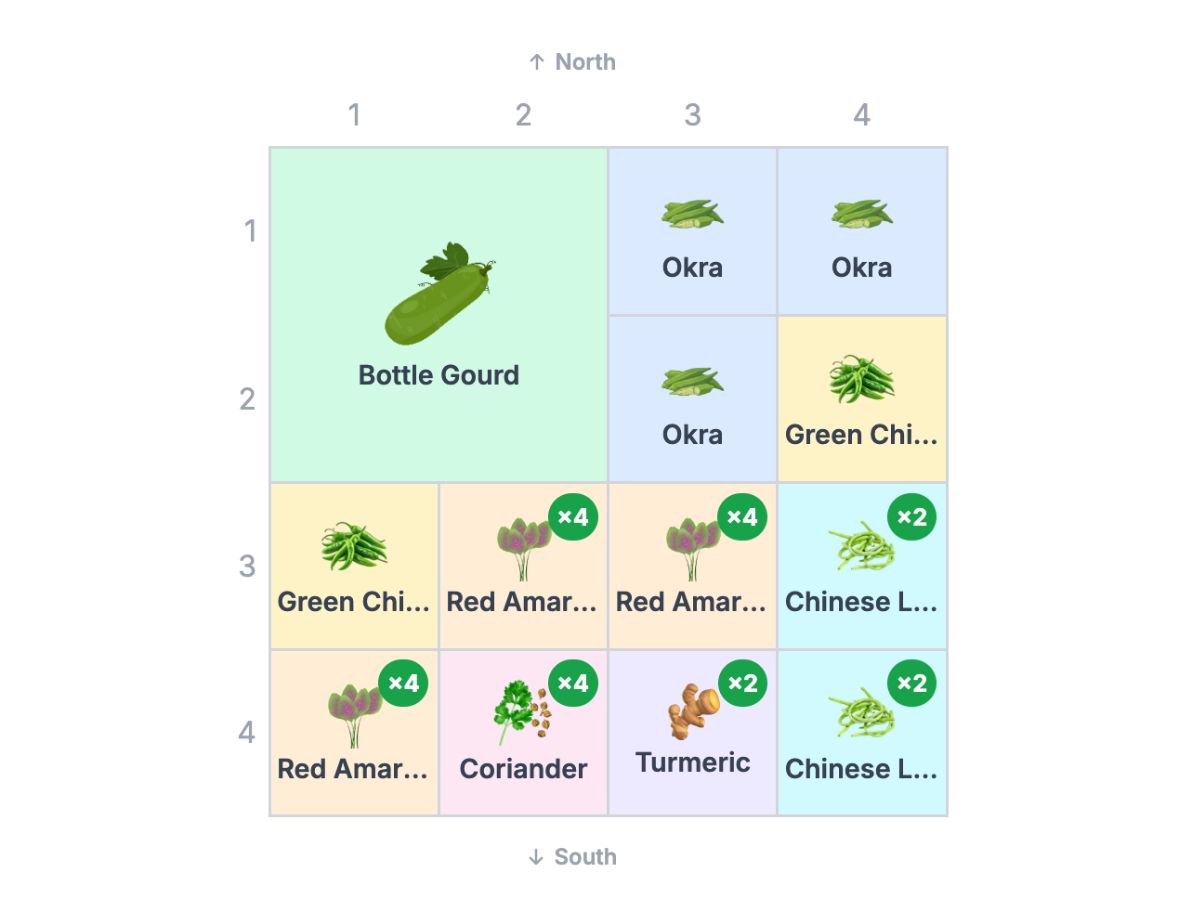
Plan 8 — Tropical & Indian Summer Bed
This layout was built for warm-climate growers and households that cook South Asian cuisine.
Bottle gourd climbs vertically from the corner — a prolific warm-season producer that takes no horizontal space when trained up a trellis.
Okra, green chillies, and Chinese long beans are the daily harvest crops.
Turmeric and coriander fill the lower squares, producing their harvest more slowly but reliably through the season.
Red amaranth is the leafy green of the bed — its purple-red leaves are both edible and ornamental, and it grows fast enough to harvest regularly without exhausting the plant.
This is a bed that suits humid, hot summers and produces ingredients that are genuinely expensive to buy fresh at quality.
What's in it: Bottle Gourd, Okra, Green Chillies, Coriander, Turmeric, Red Amaranth, Chinese Long Beans
Best for: South Asian / tropical cuisine, hot and humid climates | Season: Hot summer
View the full grid layout, see companion pairings, and copy this plan to your account.
View & Copy This Plan → Free account required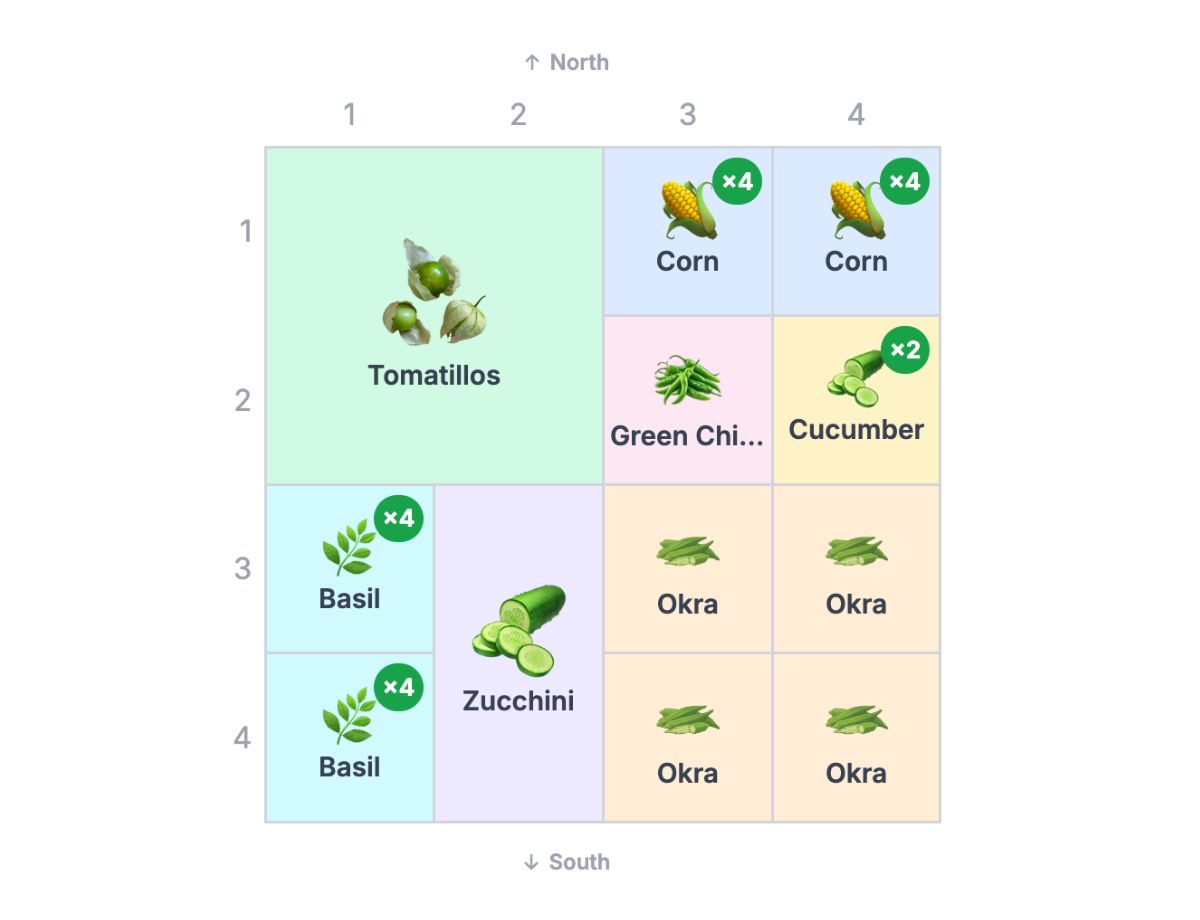
Plan 9 — High-Yield Warm Season Bed
This plan is optimised for total harvest volume. Tomatillos and corn anchor the tall positions on the north side. Okra fills the mid-height zone, producing pods in rapid succession through the heat of summer.
Zucchini occupies one corner square — one plant is enough to produce more than most households can use. Cucumber climbs a trellis alongside the corn, which provides natural shade and structural support.
Basil and green chillies fill the remaining squares. The corn-zucchini pairing is a classic companion combination: the corn stalks give climbers something to lean on, while the zucchini leaves shade the soil and suppress weeds.
For a 4×4 bed, this plan delivers exceptional harvest volume through peak summer.
What's in it: Tomatillos, Corn, Cucumber, Green Chillies, Zucchini, Okra, Basil
Best for: Growers who want maximum summer output from a small footprint | Season: Peak summer
View the full grid layout, see companion pairings, and copy this plan to your account.
View & Copy This Plan → Free account required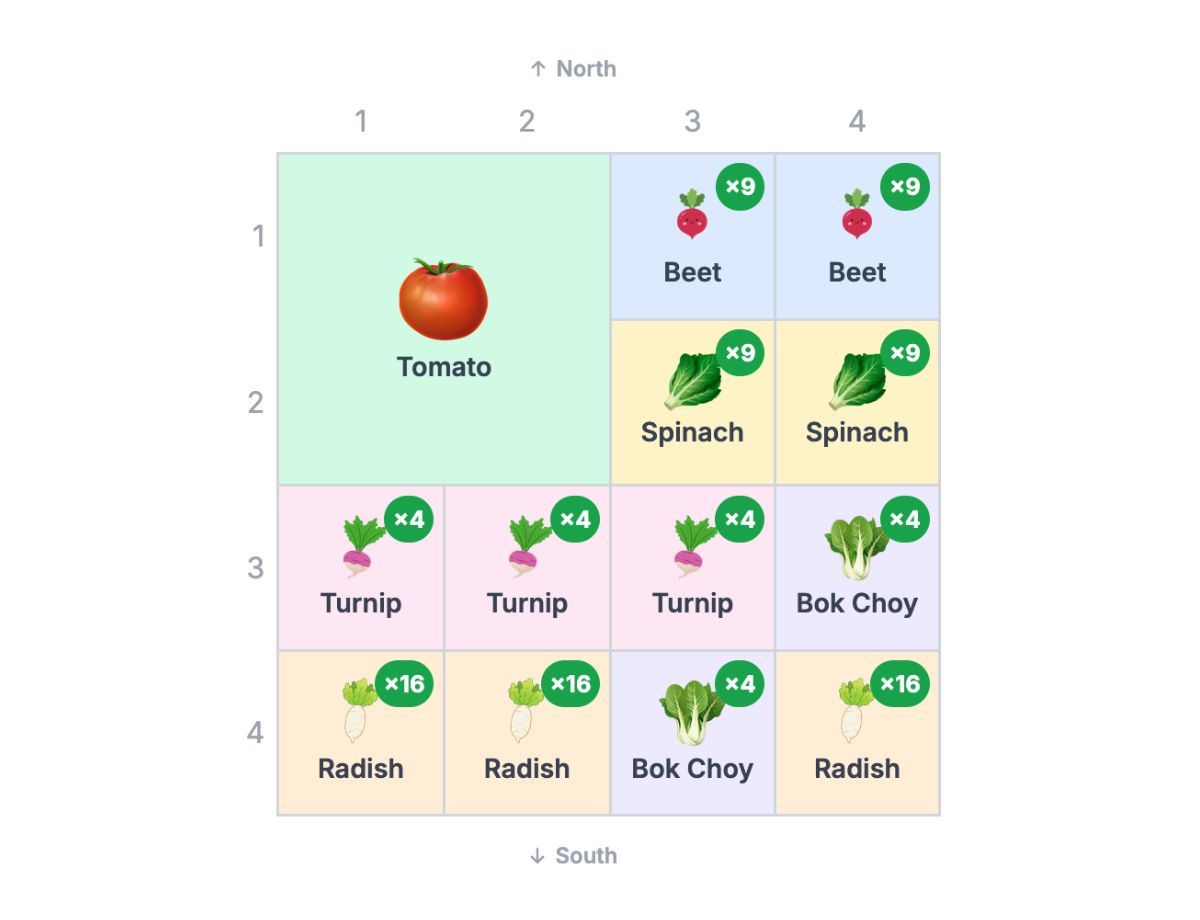
Plan 10 — Low-Maintenance Root & Greens Bed
This is the 4×4 for growers who want results without constant attention. No staking, no sprawl management, no daily checking for pests on fruiting crops. Beet, radish, turnip, and spinach grow quickly and require little intervention.
Bok choy fills in between, producing compact heads that harvest cleanly. A single tomato plant gives the bed one main fruit crop without dominating it.
Radish is the fastest crop in the bed — in the ground and harvested in under a month, which frees the square for a second sowing before summer ends.
Spinach and radish sit adjacent as confirmed good companions.
This plan also works well as an autumn bed: beet, turnip, and bok choy all tolerate light frost and continue producing when summer crops have finished.
What's in it: Tomato, Beet, Spinach, Turnip, Bok Choy, Radish
Best for: Busy gardeners, beginners, autumn growing | Season: Spring, summer, and autumn
View the full grid layout, see companion pairings, and copy this plan to your account.
View & Copy This Plan → Free account requiredHow to Adapt Any of These Plans to Your Space
These ten plans are starting points. Any of them can be adjusted for your climate, season, or cooking preferences without losing the underlying structure.
Swap crops you will not eat. There is no point growing bitter gourd if you have never cooked with it. Replace any unfamiliar crop with a well-known equivalent of similar size — swap bitter gourd for climbing cucumber, replace rutabaga with turnip, substitute tomatillos with more tomatoes. Spacing rarely changes between crops of similar scale.
Adjust for your season. Plans 2 and 10 are built for cool weather and can be planted in early spring or late summer. Plans 1, 5, and 8 need real heat and should not go in until after last frost. Plans 3, 6, and 9 are peak summer producers and should be timed to mature in the hottest months of your growing season.
Place tall crops on the north side. Every plan assumes you are in the northern hemisphere with the taller plants — tomato, corn, bottle gourd — on the north side so they cast shadow away from the bed. If your location works differently, rotate the plan orientation before planting.
Run two 4×4 beds back to back. The most common upgrade from a single 4×4 is a second complementary bed. A summer kitchen bed (Plan 3) alongside a companion planting bed (Plan 7) gives you greater variety and a built-in rotation for the following year.
Most Common Mistakes in a 4×4 Bed
Planting one large crop that takes over. A single zucchini plant in a 4×4 bed feels appropriate in May. By July, the leaves can cover four or five adjacent squares and the whole bed is fighting for light. Plans that include zucchini allocate exactly one plant, and that is already at the limit. Do not add a second.
Placing tall crops in the wrong corner. Tomatoes, corn, and bottle gourd all reach above 1.5 metres. Put them on the south side of the bed and they cast shadow over every other crop for eight hours a day. Always put tall crops on the north edge (northern hemisphere) regardless of where the bed entrance is.
Not using vertical space. A 4×4 ground footprint supports significantly more growing volume than 16 square feet suggests — if you use a trellis. Cucumber, beans, bitter gourd, and bottle gourd all climb naturally. Train them upward rather than letting them sprawl and you effectively double the productive volume of the bed without adding a square inch of ground space.
Underwatering in summer. Raised beds and small beds dry out faster than in-ground plots. In peak summer, a 4×4 raised bed can need watering every day in the absence of rain. Consistent moisture is especially important during fruiting — irregular watering of tomatoes and peppers causes blossom drop and fruit splitting. Mulch the surface to slow moisture loss significantly.
Plan the full season, not just summer
EdenVatika's planting calendar connects to your hardiness zone and shows exactly when to sow, transplant, and harvest every crop in your 4×4 bed — including autumn successions. Try it free →
Frequently Asked Questions
How many plants can you fit in a 4×4 raised bed?
Anywhere from 6 to 80 plants, depending on what you grow. A 4×4 bed with one tomato, one zucchini, two peppers, and four basil plants contains 8 plants but uses the space well.
A 4×4 salad bed can hold 64 spinach plants and 16 lettuce plants across 8 squares — a very different use of the same space. The square foot method provides density guidelines for each crop; match your plant choices to those guidelines and the bed will not be overcrowded.
What vegetables grow best in a 4×4 raised bed?
Compact and medium-height crops perform best: peppers, tomatoes (staked), cucumbers (trained vertically), lettuce, spinach, arugula, carrots, radishes, beets, spring onions, garlic, and herbs of all kinds.
These all fit within the 16-square-foot envelope without overwhelming the bed. Use sprawling crops like zucchini sparingly — one plant maximum. Avoid indeterminate squash, watermelon, and pumpkin altogether in a 4×4.
Should I use a 4×4 or a 4×8 raised bed?
A 4×4 is easier to manage and fits in tighter spaces. You can reach every square from the edges without stepping on the soil. A 4×8 gives you twice the growing area and allows for better variety and succession planting, but it requires a longer reach to the centre squares.
For a first bed, 4×4 is often the right choice — it is less investment, easier to maintain, and teaches you the core skills that scale to a larger bed the following year. If you already have a 4×4 and want to expand, adding a second 4×4 or upgrading to 4×8 are both good paths.
How often do I need to water a 4×4 raised bed?
In warm weather, a 4×4 raised bed typically needs watering every 1–2 days. The small volume of growing mix dries out faster than in-ground soil, especially in hot or windy conditions.
An inch of water per week — around 40 litres — is the standard guideline, but adjust based on heat and rainfall.
Mulching the surface with straw or wood chips can cut watering frequency by half. A drip irrigation system on a timer is worth the investment if the bed is in a hot or exposed position.
Can I grow tomatoes in a 4×4 raised bed?
Yes, but limit to one plant. A single indeterminate tomato in a 4×4 will grow vigorously and produce well through the season, but two plants will compete for resources.
Choose a determinate or compact variety if you want more flexibility with the remaining squares. The plans above that include tomatoes all allocate one plant and use the remaining space for lower-growing companions — this ratio works well in practice.
Start with a Plan That Already Works
Copy any of these 4×4 plans to your garden — free
Create a free EdenVatika account, copy the plan, edit it to fit your season, and get a full planting calendar with sow and harvest dates for your hardiness zone.
The ten plans above cover the full range of what a well-planned 4×4 bed can do: fresh herbs and salad for daily harvests, cool-season roots and brassicas for spring and autumn, summer kitchen staples, Asian and stir-fry cooking ingredients, tropical and South Asian crops, a beginner companion bed, a high-yield summer layout, and a low-maintenance option for growers who want results without complexity.
A 4×4 bed rewards planning more than any other size. Pick one of these layouts, copy it, and adjust a square or two to match what you actually cook with. The spacing, companions, and layout logic are already handled — what remains is just the planting.